the university of Virginia Ivy Corridor District Landscape
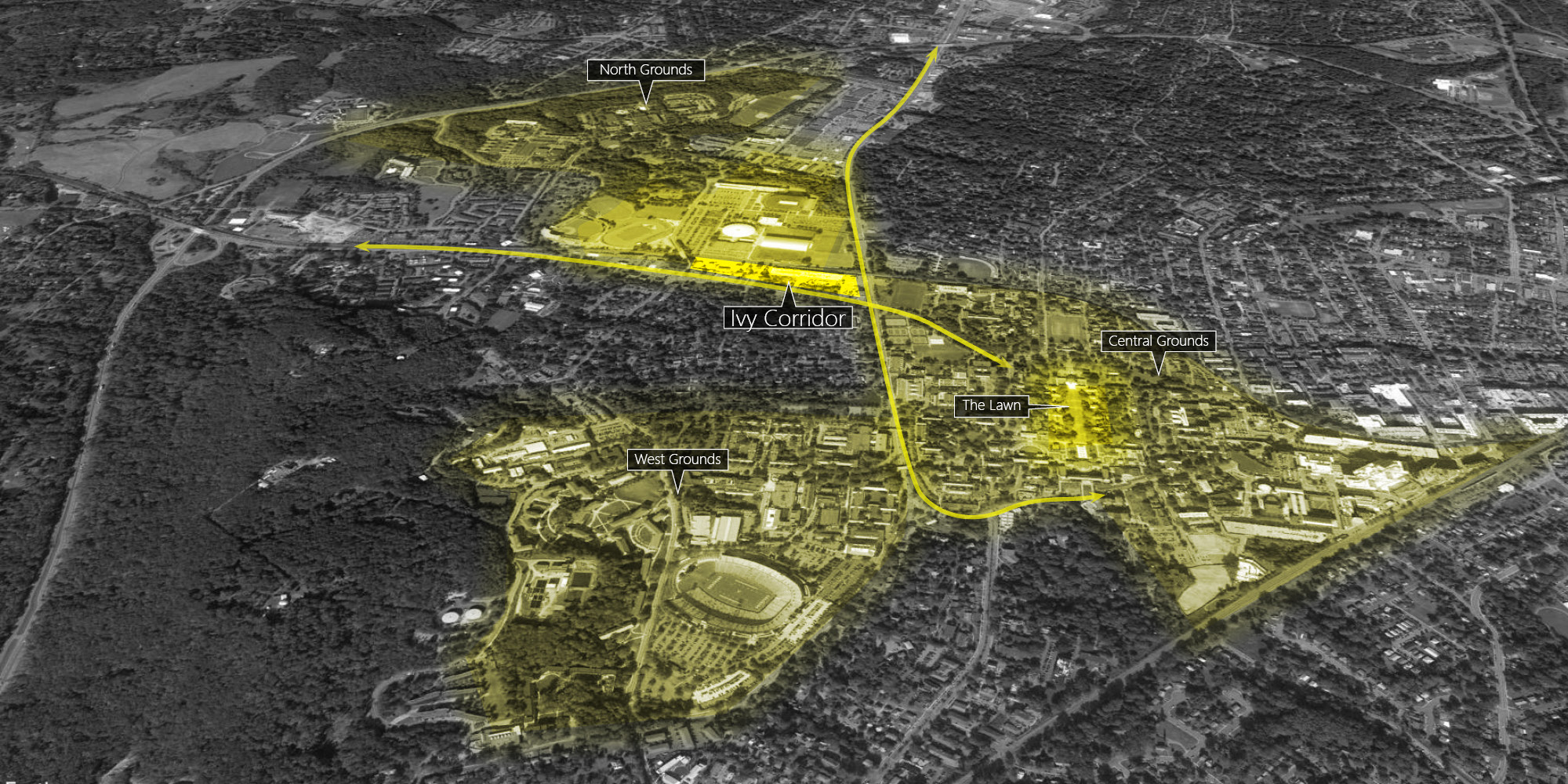
The creation of the Ivy Corridor District began as a strategic district study led by DumontJanks in 2016. That idea outlined the transformation of a 14-acre parcel, seen as the potential uniting district between north grounds and historic central grounds on campus. The parcel, roughly the size of the historic UVA Lawn and pavilions, with 45’ of elevation change over 1500’, will be transformed from its current pattern of remnant woods, suburban commercial, hotel, and parking uses, into a new academic and mixed-use district of approximately one million two hundred and fifty thousand square feet. The key organizing idea is a terraced central preserve composed of a restored stream valley (the site contains a partially buried and exposed stream), bold bosques of indigenous trees, and a strong pedestrian environment of walks and bridges connecting the preserve and buildings along the entire length of the parcel. The plan was approved by the Board of Visitors in late 2017.
DumontJanks has led a diverse team of civil engineers, structural engineers, transportation engineers, biologists, ecologists, and hydrologic engineers to bring the approved district idea to implementation and regulatory approvals. The district will be composed of collaborative academic, performing arts, two museums, new hotel and conference facilities, residential, and support office and retail uses to create a vibrant and connective district on Grounds. The DumontJanks team is responsible for the entire composition of all site development, planning, programming, and massing studies of all architectural elements, infrastructure (public and university), streets, public frontage, and a connective system of internal walks, bikeways, and vehicular and pedestrian bridges on site.
Specific to the landscape idea is the need to restore a central stream valley to the district in two distinct phases. In the lower, larger Phase I, this entails constructing an approvable stream/water way that meets and exceeds biological, water quality, and water storage aspirations for a 180-acre diversified, disturbed and undisturbed, upstream watershed. The terraced water course and its supporting landscape must accommodate seasonal stormwater fluctuations and mitigate historic flooding downstream. The stream valley and stormwater storage therefore necessitates an understory and tree regime (indigenous river birch and sycamore) that can endure and thrive in saturated and inundated environments. The water terraces lead to a major water element and amphitheater at the corner of the site looking east to Central Grounds and the Rotunda.
In the upstream Phase II site, the watershed is essential to the remaining five-acre site. The idea captures all runoff from new building roofs, pavements, and planted areas, and imagines the center preserve as an upstream tributary to the lower Phase I preserve.
DumontJanks has completed design for the multiphase project and has been providing construction administration and observation services for the landscape and building sites for the entire district.
Our work on the Ivy Corridor received ASLA and SCUP Honor Awards for Excellence in Landscape Architecture for District Planning, Design, and Open Space Planning.


